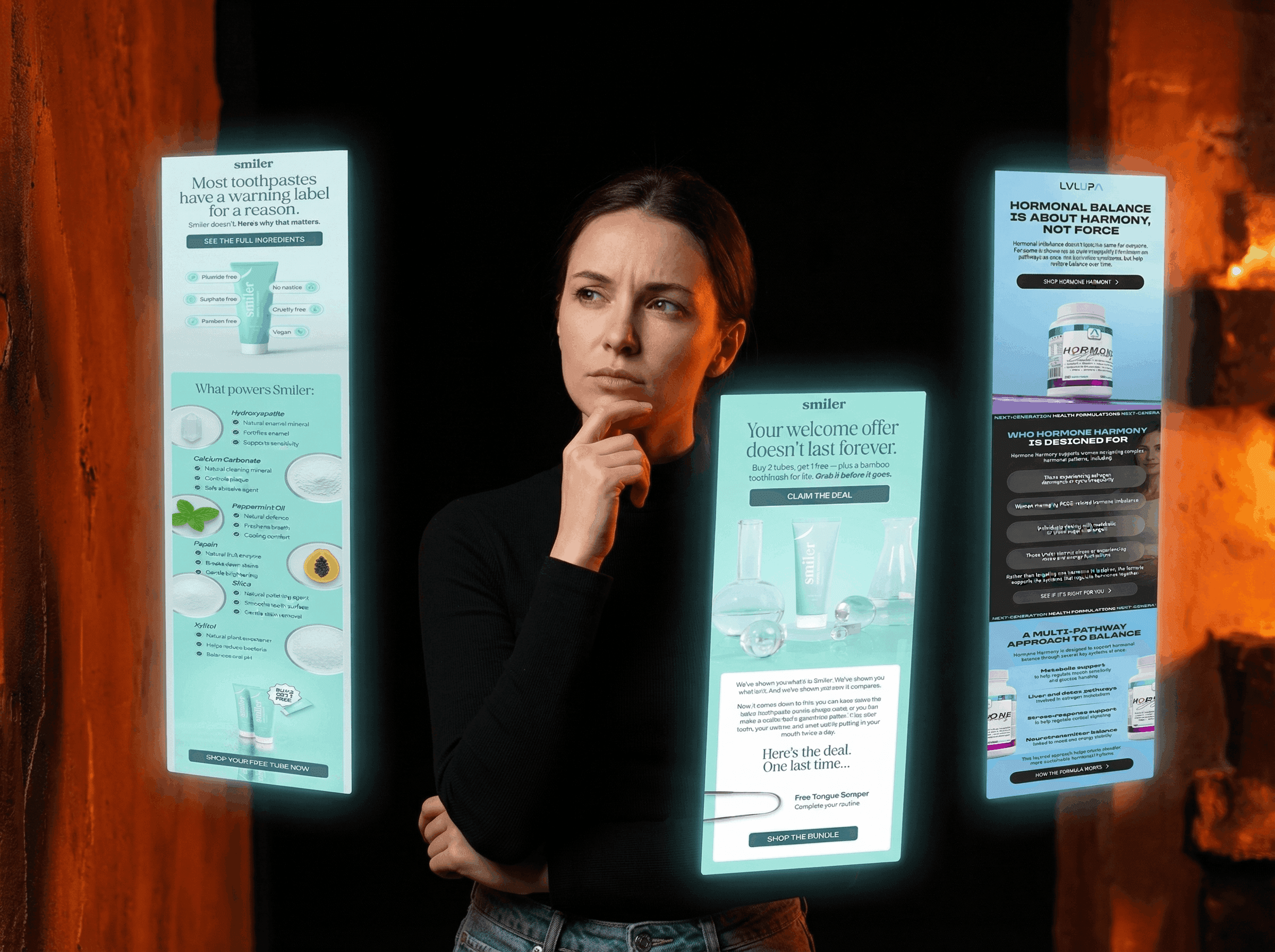
At some point, most growing email marketing agencies hit the same wall: design capacity.
You need more creative output than you or your current team can produce, so you start weighing your options. Hire a designer? Bring in a freelancer? Partner with a design agency? This freelancer vs design agency vs in-house comparison looks at where each option fits for an email marketing agency. All three have their place, but for most agencies that are actively scaling, one tends to fit better than the others.
Here's an honest breakdown.
Option 1: Freelancers
Freelancers are usually the first port of call. They're quick to find, flexible to use and often affordable. That makes them a natural choice when you're taking on your first few clients. If you go this route, our guide on where to find a Klaviyo email designer compares the main places to look and how to vet them.
Freelancer pros
Low commitment: you can hire per project with no ongoing obligation
Wide talent pool: you can find specialists for almost any style or niche
Often cost-effective for small, one-off projects, such as a single launch campaign
Freelancer cons
Availability can be unpredictable: most freelancers juggle several clients, so your deadline won't always be their top priority
Quality can vary: output often shifts between projects, which makes client brands harder to keep consistent
Limited accountability: if a freelancer goes quiet mid-campaign, you're the one explaining the delay to your client
Harder to scale: one campaign is comfortable; twenty across several brands in the same month is a different job
Freelancers often work well in the early days. As your client list grows, though, relying on one or two people you don't control gets harder, and a missed deadline lands on your agency's reputation, not theirs. That's usually when agency owners start thinking about hiring.
Option 2: Building an In-House Team
Bringing design in-house feels like the 'proper' solution. You get full control, direct communication and designers who are fully immersed in your agency's work. The trade-off is a fixed cost, whether the work is there or not.
In-house pros
Full control over quality, priorities and output
Deep familiarity with your clients, brands and processes
Available during your working hours, without competing with other clients for their time
In-house cons
Expensive: salary, benefits, software, equipment and management time
Slow to set up: recruiting and getting a designer up to speed on every client brand can take weeks or months
Skill gaps: one or two designers can't realistically cover every style, niche and format your clients need
Fixed capacity: during quiet periods you're paying for idle time, and during peaks like BFCM your team is still capped at what they can produce
In-house tends to work best for larger agencies with predictable, high-volume output. For many growing agencies it's a heavy commitment to make early, which is where the third option comes in: the reliability of a team without the overhead of employing one.
Option 3: A White Label Design Partner
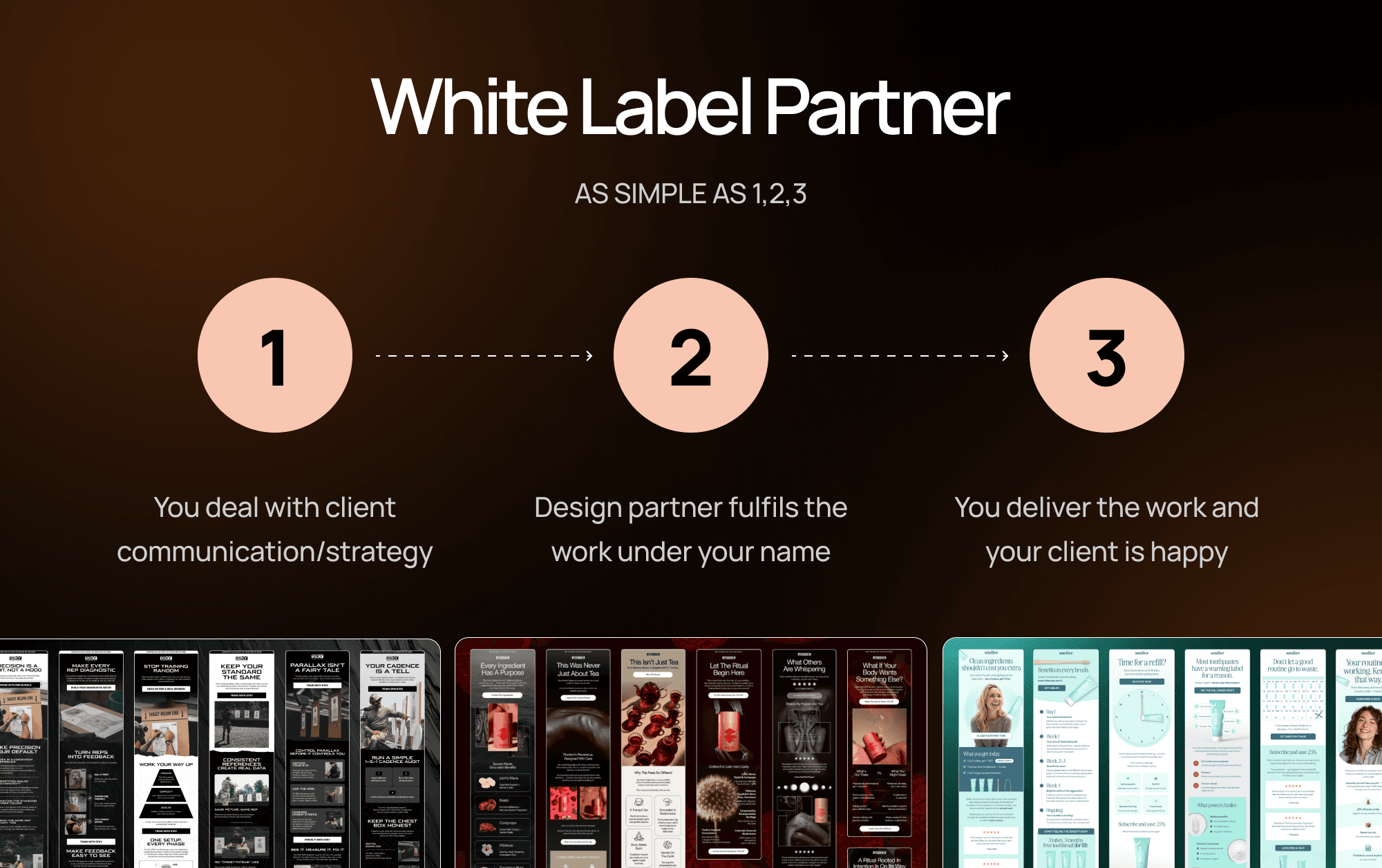
A white-label design partner is a specialist design agency that works with agencies, delivering creative under your name and fitting into your existing workflow. It sits between the two options above: more structure than a freelancer, more flexibility than a full-time hire.
Design partner pros
More reliable delivery: a team rather than one person means holidays and busy weeks are less likely to stall your campaigns
Clear turnaround times: a good partner commits to them upfront. Marz's stated turnaround, for example, is first drafts within 72 hours of a complete brief and revisions back the same day
Flexible capacity: you can scale requests up or down as clients come and go, without hiring or letting anyone go
Lower overhead: no salaries, no recruitment, less time managing designers
Specialist expertise: an ecom email partner already knows promotional layouts, product hierarchy and mobile-first design
Design partner cons
Less direct control than in-house, so look for clear communication and a defined revision process
Requires solid briefing: the better your brief, the better the output
For many growing email marketing agencies, a design partner hits a useful middle ground between flexibility and reliability. It isn't automatically the right answer for everyone, though, so the next step is matching the option to where your agency actually is.
Freelancer vs Design Agency vs In-House: Which Is Right for You?
There's no universal threshold where one option becomes the right one. Client count is a useful starting point, but the real answer also depends on your workload, campaign volume, budget and how predictable your demand is from month to month. Treat the guidelines below as illustrations rather than rules:
Just starting out (roughly 1–3 clients): if your volume is low and irregular, a reliable freelancer can work fine for now.
Growing fast (roughly 4–10 clients): if you're onboarding new brands regularly and campaign volume swings month to month, a design partner is often the most practical move. Capacity flexes with demand, without a salary to cover.
Established (roughly 20+ clients with predictable volume): if your workload is steady and your budget supports it, a mix of in-house designers and a design partner can give you control day to day and extra capacity for peaks and new clients.
Between these stages, look at the pattern of your work rather than the number of logos: steady volume makes hiring easier to justify, while spiky or fast-growing demand usually favours a flexible partner.
The agencies that scale well aren't necessarily the ones with the biggest teams. They're the ones that build reliable systems early, and a dependable design setup is one of the most important.
That was the case for Alex from Profit Over Promos. His agency had fallen behind because of unreliable freelancers, so Marz onboarded his brands within 24 hours and completed the month's campaigns in the first few days. You can read Alex's testimonial and other agency stories on our white-label email design page.
Thinking about partnering with a specialist design agency?
If a design partner sounds like the right fit for your stage, see how white-label email design for agencies works with Marz, from the Slack channel to final Figma delivery.
Keep reading
Going the partner route? Read outsourcing email design: the agency playbook.
Weighing a hire against a partner? See Marz Media vs hiring a designer.
Still relying on freelancers? Read the hidden cost of unreliable designers.
Liked it? Share it with your people.


Us Vs Them
Launch your creative to new realms — fast, reliable, and scalable
Large agencies spread thin often lack the focus and flexibility to bring your visions to life.
Cover some needs well, but struggle with skill gaps and aren’t easily scalable.
Finding the right freelancer can be awesome, until they reach capacity or you suddenly get ghosted.
More Blogs
Marz Media is a specialized design partner for agencies that need consistent output without capacity issues.

Oct 7, 2026
Why Your Welcome Flow Deserves Better Email Design
Design a welcome flow that makes a strong first impression. Learn how better email design can improve brand consistency, guide conversions, and build long-term subscriber engagement.
READ MORE

Oct 7, 2026
Why Do Your Emails Still Miss the Mark If the Brief Was Good?
Discover why clear email design briefs may miss the mark and how aligning strategy, CTA hierarchy, and technical specs leads to stronger first-draft designs.
READ MORE
Mar 3, 2026
White Label Email Design: The Complete Guide for Ecom Agencies
Complete guide to white label email design for ecom agencies: how it works, why agencies outsource, how to choose a partner and the mistakes to avoid.
READ MORE