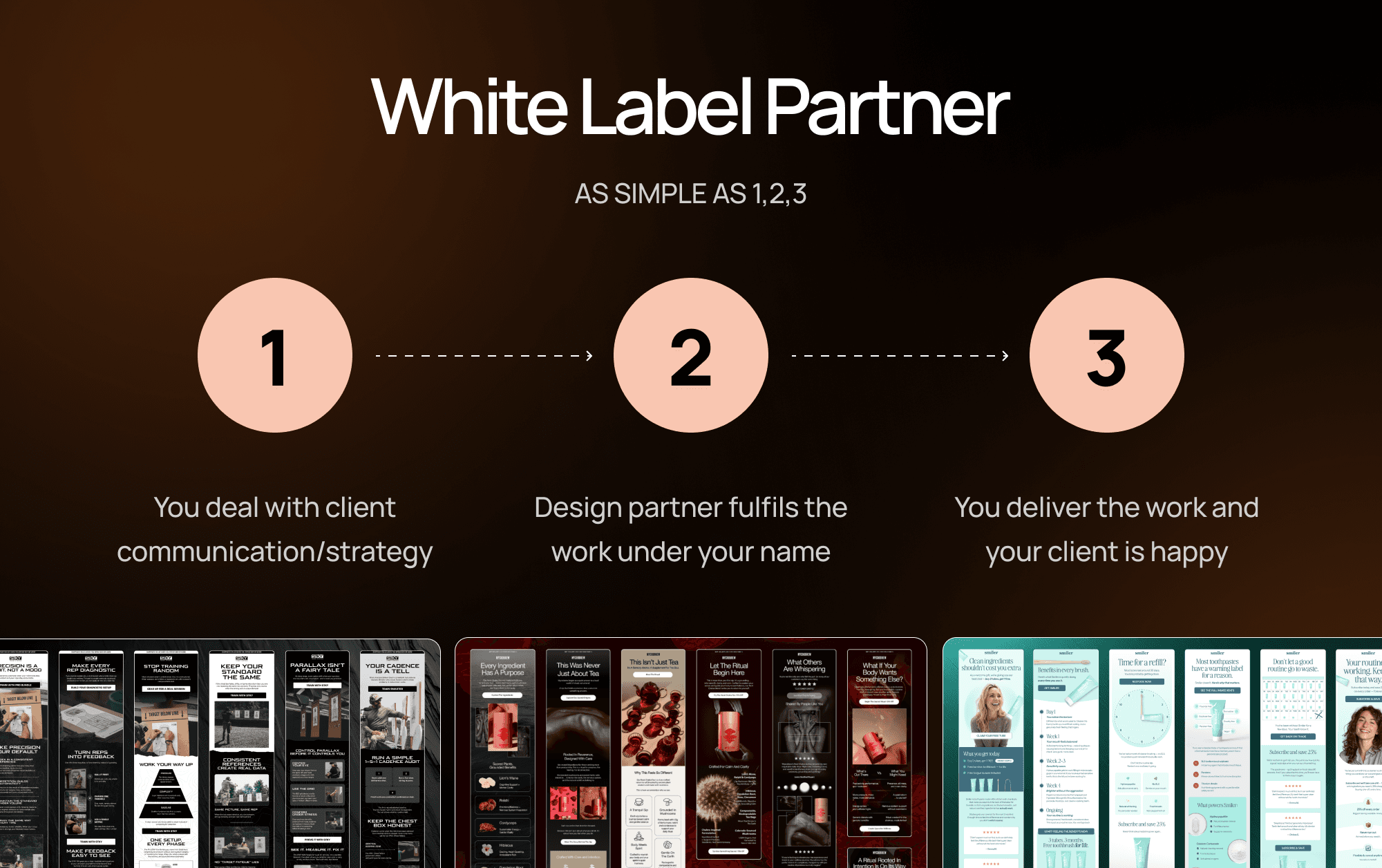
White label email design means an external design team produces your clients' emails, and you deliver them under your agency's name. For ecom agencies, it's a way to add design capacity without hiring, while you keep ownership of strategy, client communication and quality control.
If you run an email marketing agency, you've probably heard the term thrown around. This complete guide to white label email design for ecom agencies covers what it is, why agencies use it, how the workflow runs day to day, what to look for in a partner, and the mistakes that make partnerships harder than they need to be.
What Is White Label Email Design?
White-label email design is when your agency works with an external design partner to produce creative for your clients, and that work is delivered as your agency's own. The partner doesn't brand the work, doesn't contact your clients and doesn't appear in your reporting. As far as your client is concerned, the emails come from your team.
The client relationship stays exactly where it was. You still win the account, set the strategy, agree the campaign calendar and present the work. The design partner sits behind your agency as an extension of your team, taking briefs from you and returning designs to you. Klaviyo itself can't be rebranded, as we explain in does Klaviyo offer white label?, so the white-label part is the service your agency delivers.
Think of it like a restaurant that sources its bread from a specialist bakery. The restaurant still sets the menu and answers to the diner; the bakery makes sure the bread is consistently good. The analogy has limits, though: email design is an ongoing collaboration, with a new brief for every campaign.
What white-label delivery means in practice
No partner branding: files, previews and comments carry no trace of the design partner
You're the only point of contact: the partner talks to your team, never directly to your client
Handover-ready files: designs arrive in a format your team can present and build from. At Marz, approved designs are delivered in Figma, ready to hand to the client
Your process, not theirs: a good partner works inside your existing workflow rather than asking you to rebuild it
Once the model is clear, the next question is why so many agencies choose it over building their own design team.
Why Do Agencies Use White Label Design?
Most agencies don't go looking for a white-label partner on day one. They start using one when design becomes the thing holding growth back. These are the most common reasons.
1. More design capacity without adding headcount
Every new client brings flows, campaigns and a brand to learn. If your output is fixed at what one or two designers can produce, each new account squeezes the rest. A white-label partner lets you take on more work without stretching your team. Jack, founder of Mail Mosaic, described design as the only bottleneck in his agency; once it was handled, his team picked up four brands immediately.
2. Avoiding the time and overhead of hiring
Hiring a designer means recruitment, onboarding, salary, software and management time, all before they've learned your clients' brands. For a growing agency, that's a large fixed cost to commit to before you know whether the extra volume will last. A partner shifts that cost to something that tracks your workload. If you're still weighing the options, our comparison of freelancers, design agencies and in-house teams breaks down the trade-offs.
3. Handling workload fluctuations
Email agency workloads are rarely flat. New client launches, product drops and peak periods like Black Friday can pile on extra work within a few weeks before it drops off again. An in-house team is either overloaded at peak or under-used in quiet months. A white-label partner gives you room to flex. Jordan, founder of EFB, relies on Marz in peak periods for exactly this reason.
4. Keeping your team focused on strategy and clients
Every hour your strategists spend pushing pixels or chasing designers is an hour not spent on campaigns, segments and timing. Outsourcing design production frees your team to focus on planning, reporting and the client relationships that keep accounts renewing.
5. Access to specialist ecom email skills
Ecom email design is a specialism. Product grids, promotional hierarchy, mobile-first layouts and designs that hold up once they're built in Klaviyo all take practice. A specialist ecommerce email design agency brings that experience across many brands and niches, which is hard to match with a single generalist hire.
Knowing why agencies outsource email design is useful, but the benefits only show up if the day-to-day workflow runs smoothly. Here's what that looks like.
How It Works in Practice
The process is simpler than most agency owners expect, but each party has a clear role. Your agency owns the client and the brief. The design partner owns production. Your agency then owns the review and final delivery. For a side-by-side of the two roles, see how a design agency and an email marketing agency split the work. A typical workflow looks like this:
You win the client and gather the essentials. Collect the brand guide, logo files, fonts, product imagery and any past emails that performed well. This becomes the reference for every design that follows.
You write the brief. For each email, set out the goal, audience, offer, key products, copy (or copy direction), deadline and the one action you want the reader to take. A complete brief is the biggest single factor in how quickly and accurately a partner can deliver.
You send it to your design partner. This should happen through a shared, trackable system rather than scattered messages. At Marz, each agency gets a dedicated Slack channel (most are live within 24 hours of signing up), and requests go through the Marz app, where the brand guide, brief and assets sit together and every request is tracked.
The partner designs the first draft. Turnaround depends on the partner and on the brief. Marz's stated turnaround for email is first drafts within 72 hours of a complete brief.
You review internally. Before anything reaches the client, your team checks the draft against the brief and the brand guide. A consistent pre-delivery email design checklist keeps this quick and objective.
You request revisions. Group your feedback into one clear, specific round where you can. Marz returns revisions the same day.
You present the final design as your own. Once approved, you share the design with your client, handle their feedback and move it into build.
Throughout, your agency stays responsible for the client relationship and for signing off quality. The partner supports your process; it doesn't replace your judgement. That's why choosing the right partner matters so much.
What to Look for in a White Label Email Design Partner
Not every partner will deliver the same results, so it's worth evaluating a few before committing. These are the criteria that matter most, with questions to ask on a discovery call. For a longer list, with a good answer and a red flag for each, see our scorecard for choosing a white-label email design partner.
1. Ecom specialisation
Generic designers can produce attractive emails that don't sell. You need a partner who understands ecom email specifically: product hierarchy, promotional layouts, mobile-first design and how to balance brand feel with conversion. Our breakdown of what makes high-converting ecom email design is a useful benchmark when reviewing a portfolio.
Ask: Can you show emails for brands in my clients' niches? How do you approach mobile layouts?
2. Proven, realistic turnaround times
Speed matters, but consistency matters more. A partner who quotes a fast turnaround and misses it is harder to plan around than one who commits to a realistic timeline and meets it. Look for stated turnaround times for first drafts and revisions, and what they depend on.
Ask: What's your standard turnaround for a first draft and for revisions? What counts as a complete brief? What happens when a deadline is at risk?
3. Brand accuracy and onboarding
Your clients trust you with their brand identity, so a partner needs a clear process for learning each brand quickly. Expect a short learning curve rather than perfection on day one, but it should be short. Elliot at Dispatch Agency, whose clients have strict guidelines, said Marz had nailed the brand feel by the second email.
Ask: How do you onboard a new brand? What do you need from us? How do you keep different clients' styles distinct?
4. Communication and revision process
Day to day, this is what you'll feel most. Check where conversations happen, how quickly the partner responds, how revisions are requested and tracked, and whether there's a limit on rounds.
Ask: Which channel do we use? How are requests tracked? How do revision rounds work?
5. Scalability
Your design needs will fluctuate as clients come and go and peak season arrives. A good partner can absorb busier months without quality dropping, and pricing should reflect your workload rather than locking you into capacity you don't use.
Ask: How do you handle a sudden jump in volume, such as BFCM? How does pricing change as our workload changes?
6. Relevant experience and real results
Anyone can promise quality; the best partners can show it. Ask for case studies or testimonials from other agencies, ideally ones similar in size and client mix to yours. A trial or a small first project is a low-risk way to test the fit. Daniel at EcomAdvertisers started with a one-month trial before handing over all his email creatives.
Ask: Which agencies do you work with? Can we start with a trial or a small batch of emails?
Common Mistakes Agencies Make
Even with a strong partner, a few avoidable habits can slow everything down. These are the ones we see most often.
Choosing the cheapest option
White-label design carries your agency's name, so its quality is your reputation. The cheapest option often costs more in revision rounds, missed deadlines and time your team spends fixing work. Compare partners on reliability and quality first, then on price.
Not briefing properly
A vague brief produces a vague first draft, which means more rounds of feedback and slower delivery. Use a standard brief template covering the goal, offer, products, copy and deadline for every email, and attach the brand guide and assets each time.
Skipping internal review
Your agency is accountable for what the client sees, so build in a quick review against the brief and a checklist before anything goes out.
Setting unrealistic timelines
Sending a brief the day before a campaign launches puts pressure on everyone and leaves no room for feedback. Plan your campaign calendar with the partner's turnaround and at least one revision round built in, and share upcoming peaks early.
Waiting until you're already behind
Many agencies only look for a partner once deadlines are slipping, which makes onboarding more stressful than it needs to be. Alex, founder of POP, had fallen behind because of unreliable freelancers; Marz onboarded his brands within 24 hours and completed the month's campaigns in the first few days. Starting before the crunch gives you time to test the fit calmly.
Treating it as a short-term fix
The best results come from long-term partnerships, where your design partner builds up knowledge of your clients, their brands and your standards. Treat the partner as part of your team: share context, give feedback on what's working and involve them in planning ahead.
Is White-Label Email Design Right for Your Agency?
White-label email design for agencies tends to be a good fit when design is your main bottleneck, your workload changes month to month, you're onboarding new clients faster than you can hire, or you want your team focused on strategy rather than production. If your volume is low and steady, a freelancer or a single hire may be enough for now.
Whichever partner you choose, the partnership works best when you have a few things in place:
Clear briefs: a standard template so every request starts complete
A feedback process: one owner on your side who reviews drafts and consolidates feedback
Realistic timelines: a campaign calendar that allows for first drafts and revisions
Organised brand assets: guides, fonts and imagery for each client in one place
A quality check: an agreed checklist before anything reaches the client
With those foundations, a white-label partner becomes a dependable part of how your agency delivers, rather than another supplier to manage.
FAQ
Will my clients know I use a white-label design partner?
Not unless you tell them. A white-label partner works only with your team, adds no branding to the work and never contacts your clients directly.
Is white-label email design the same as outsourcing?
It's a type of outsourcing. When you outsource email design on a white-label basis, the work is presented as your agency's own and the partner stays behind the scenes, rather than working with your client as a separate supplier.
What do I need before I start?
A brand guide and assets for each client, a brief template and someone on your team to own reviews. With those ready, onboarding a partner can be quick. At Marz, most agencies are live in their Slack channel within 24 hours of signing up.
Thinking about adding a white label design partner to your agency?
See how white-label email design for agencies works with Marz, from your dedicated Slack channel to approved designs delivered in Figma.
Keep reading
Ready to start? Here's how to outsource email design without losing quality.
With a partner in place, you can onboard a new client in 24 hours.
Liked it? Share it with your people.


Us Vs Them
Launch your creative to new realms — fast, reliable, and scalable
Large agencies spread thin often lack the focus and flexibility to bring your visions to life.
Cover some needs well, but struggle with skill gaps and aren’t easily scalable.
Finding the right freelancer can be awesome, until they reach capacity or you suddenly get ghosted.
More Blogs
Marz Media is a specialized design partner for agencies that need consistent output without capacity issues.

Oct 7, 2026
Why Your Welcome Flow Deserves Better Email Design
Design a welcome flow that makes a strong first impression. Learn how better email design can improve brand consistency, guide conversions, and build long-term subscriber engagement.
READ MORE

Oct 7, 2026
Why Do Your Emails Still Miss the Mark If the Brief Was Good?
Discover why clear email design briefs may miss the mark and how aligning strategy, CTA hierarchy, and technical specs leads to stronger first-draft designs.
READ MORE

Nov 15, 2026
Where to Find a Klaviyo Email Designer
Where to find a Klaviyo email designer: Upwork, Fiverr, Contra, Klaviyo partners or a white-label partner, plus how agencies can vet one before hiring.
READ MORE