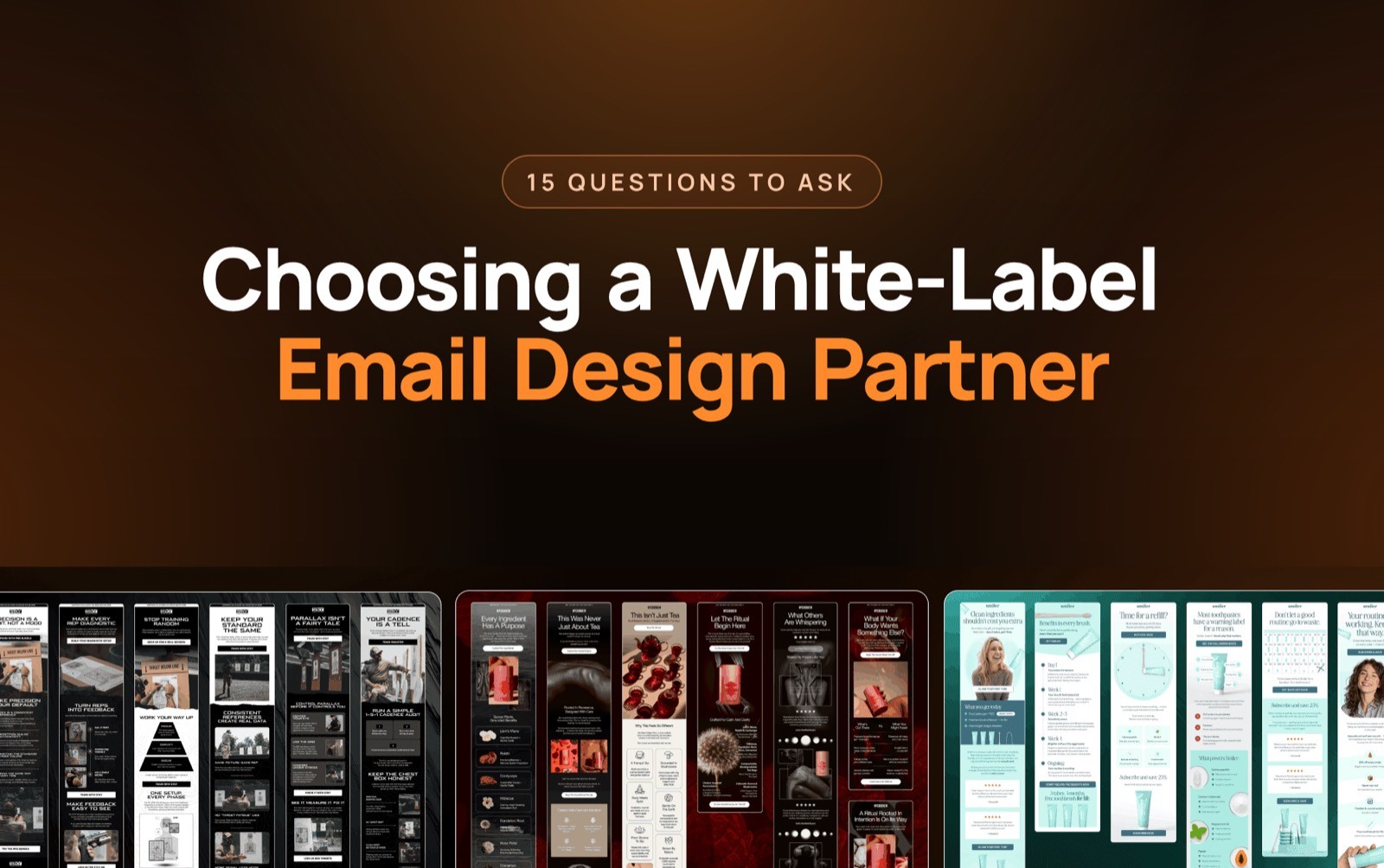
Choosing a white-label email design partner comes down to five things: the quality of their work in your clients' niches, how fast they turn a complete brief into a draft, how they fit into your process, how well they stay invisible to your clients, and whether the commercial terms let you start small. The 15 questions below cover all five. Each one comes with what a good answer sounds like and the red flag to listen for, so you can use this as a scorecard on your next partner call.
If you only have time for three, ask about turnaround from a complete brief (question 4), how they handle strict brand guidelines (question 2) and what happens in November (question 6). Those three answers tell you most of what you need to know.
What should you look for in a white-label email design partner?
A white-label email design service does the design work under your agency's name, and your clients only ever deal with you. That changes what you're buying. You aren't hiring a designer for one brand. You're adding a production line that has to handle several brands, several brand guides and your busiest weeks without anyone noticing it's there.
So the questions that matter group into five areas, each tied to a cost your agency carries if the partner gets it wrong:
Quality and fit: whether the work will pass your client's review without you redesigning it.
Speed and capacity: whether your send calendar survives a busy month.
Process and communication: how much of your team's time the partner will take to manage.
White-label and confidentiality: whether the client relationship stays yours.
Commercial terms: whether you can test the partner before you rely on them.
If you're still deciding whether to outsource at all, start with how to outsource email design as an agency, then come back to this list when you're comparing partners.
Questions about quality and fit
Quality problems are expensive because you find them late, usually when a client sends back a draft that "doesn't feel like us". These three questions surface them before you sign.
1. Can you show emails you've designed for brands like my clients?
A beauty brand, a supplement brand and a golf brand need very different emails. You want proof the partner has worked in your clients' categories, or at least in ecom.
Good answer: real campaign and flow designs, grouped by niche, with a short note on the brief behind each one.
Red flag: a portfolio of websites, social posts or generic templates, with very little ecom email in it.
2. How do you handle a brand with strict guidelines?
Your strictest client is the real test, because that's where a partner's process shows. Ask them to walk you through how they learn a new brand guide.
Good answer: a clear onboarding step per brand (brand guide, past sends, module library) and a named person who checks every design against it.
Red flag: "Just send us the logo and colours." That usually means you'll be the one catching the brand mistakes.
3. Are your designers trained in ecom email specifically?
Ecom email has its own craft: a clear single action, mobile-first layouts, product grids and offers that read in a few seconds. A general graphic designer can learn it, but not on your clients' time.
Good answer: designers who work on ecom email every day, plus a written pre-delivery checklist they can share.
Red flag: "Our designers can do anything." Range is fine, but you want depth in email.
Questions about speed and capacity
Missed send dates hurt your agency more than imperfect designs do, because your client sees the delay. These questions show whether the partner can keep up with your calendar.
4. How fast do first drafts arrive, and from when?
"48 hours" means little until you know when the clock starts. The useful version is "from a complete brief", because it puts the responsibility for a good brief where it belongs and makes the promise measurable.
Good answer: a specific turnaround measured from a complete brief, and a clear definition of what "complete" means.
Red flag: "As fast as possible." That isn't a deadline you can plan a campaign around.
5. How quickly do revisions come back?
Revisions are where timelines slip. A fast first draft followed by three-day revision loops still puts you behind.
Good answer: a stated revision turnaround (same day or next day is a sensible standard) and no surprise charges for normal rounds.
Red flag: a fixed number of revisions per email, with extra rounds billed separately. Your clients don't care about the partner's revision limits.
6. What happens to my turnaround in November?
Black Friday and Cyber Monday are when every agency needs extra design at once. A partner who is quick in March and slow in November doesn't solve your real problem.
Good answer: a plan for peak season, such as booking BFCM volume early, plus examples of agencies they supported through it.
Red flag: they haven't thought about it. If they can't describe last November, assume it was hard.
Questions about process and communication
A partner that needs constant chasing costs you management time, which is the thing you were trying to buy back. These questions show how much of it they'll take.
7. Where do we talk, and who do I talk to?
Email threads across ten brands get lost quickly. You want one place for each client's work and one accountable person on the partner's side.
Good answer: a dedicated channel (Slack is common), async by default, with a named lead who knows your brands.
Red flag: a different person on each request, or a support inbox with no names.
8. How are requests tracked and prioritised?
When you have 30 emails in progress, you need to see what's waiting, what's in design and what's due back today.
Good answer: a system where you submit briefs with assets attached, see the status of each request and change priorities yourself.
Red flag: "Just message us." That works for one brand and falls apart at five.
9. How long does it take to onboard a new client brand?
You'll win clients at awkward times. The partner should be able to pick up a new brand quickly without you rewriting your brief process for them.
Good answer: a short, repeatable onboarding step: brand kit in, a first brief, and work starting within days.
Red flag: a long discovery phase for every brand, billed separately.
Questions about white-label and confidentiality
This is the part that makes it white-label. Your clients hired your agency, so the partner has to stay out of sight while still doing work you'd put your name on.
10. Will my clients ever see your name?
A partner's name in a file or a comment can raise awkward questions about who does the work, so check how they keep themselves out of sight.
Good answer: no contact with your clients, no partner branding in files or comments, and work delivered under your agency's name.
Red flag: they ask to join client calls or put their name in file credits. Some partners use your clients as their own case studies, so ask about that too.
11. Will you sign an NDA?
You're sharing client brand guides, offer calendars and sometimes sales figures. A partner who works with agencies should expect this question.
Good answer: yes, without hesitation, plus a clear answer on who on their team can see client files.
Red flag: hesitation, or "we don't usually do that".
12. Who owns the files, and what format do I get?
If you can't edit the source files, you're locked into the partner for every small change.
Good answer: your agency owns the final designs, delivered as editable files (Figma is the standard for email) that are ready to hand to your client or your build team.
Red flag: flattened images only, or files that stay in the partner's account.
Questions about commercial terms
Commercial terms decide how much risk you take on before you know whether the partner works. Pricing models vary a lot, so focus on flexibility rather than the headline number.
13. How do you price: per deliverable, per month or per hour?
Each model suits a different agency. Per-deliverable pricing tracks your client workload. A monthly fee suits steady volume. Hourly billing is the hardest to forecast.
Good answer: a model that scales up and down with your client roster, explained in one sentence.
Red flag: you can't work out what a normal month will cost after the call.
14. Can we start with a trial?
A trial is the cheapest way to answer every other question on this list with real work, before you move your whole client roster over.
Good answer: yes, with a scope you agree in advance.
Red flag: a long commitment before you've seen a single email.
15. What's the minimum term, and how do we leave?
Good partners keep agencies because the work is good, not because the contract is hard to exit.
Good answer: short or no minimum terms, and a clear handover of files if you leave.
Red flag: long notice periods, exit fees or files held back.
Red flags that should end the conversation
Some answers aren't worth scoring. If you hear any of these, you'll probably spend more time managing the partner than you save:
No ecom email in the portfolio: you'd be paying for them to learn.
Turnaround with no starting point: "fast" or "ASAP" instead of a time from a complete brief.
They want to talk to your clients: it blurs who owns the relationship.
No answer about peak season: November is when you need them most.
A single designer behind the brand: one person on holiday stops your whole delivery. Read the hidden cost of unreliable designers for what that does to an agency.
No trial, long lock-in: confidence in the work usually shows up as flexible terms.
A simple scorecard for your partner calls
Copy this list into your notes and score each partner from 0 to 2 per area: 0 for a red flag, 1 for a vague answer, 2 for a specific answer with proof. Weight speed and white-label double, because those are the two your clients notice first.
Quality and fit (questions 1–3): niche portfolio, brand-guide process, ecom-trained designers.
Speed and capacity (questions 4–6, counts double): draft turnaround from a complete brief, revision turnaround, peak-season plan.
Process (questions 7–9): dedicated channel and named lead, request tracking, onboarding time for a new brand.
White-label (questions 10–12, counts double): invisible to clients, NDA, your agency owns editable files.
Commercial terms (questions 13–15): clear pricing model, trial available, easy exit.
A partner scoring 12 or more out of 14 is worth a trial. Below 9, keep looking. Then let the trial decide, since a sales call can only tell you so much. For a wider view of your options, compare freelancers, design agencies and in-house designers before you commit.
How Marz answers these questions
For transparency, here's how we answer the questions above at Marz. Every agency gets a dedicated Slack channel and requests go through the Marz app, where each one is tracked and prioritised. First drafts arrive within 72 hours of a complete brief, revisions come back the same day, and approved designs are delivered in Figma, ready to hand to your client. Your clients don't know we're involved.
A few of our partners have described the parts that mattered to them. Daniel at EcomAdvertisers started with a one-month trial before handing over all his email creatives. Elliot at Dispatch Agency works with brands that have strict guidelines and says we had the brand feel by the second email. Don at Hamilton Emails chose us after evaluating several creative agencies. You can read their full stories on our white-label email design page for agencies.
A partner isn't the right call for every agency, though. If you have steady, predictable volume for one or two brands and time to manage a designer, hiring in-house can make more sense. We've laid out that trade-off honestly in Marz vs hiring a designer.
White-label email design partner FAQ
What is a white-label email design service?
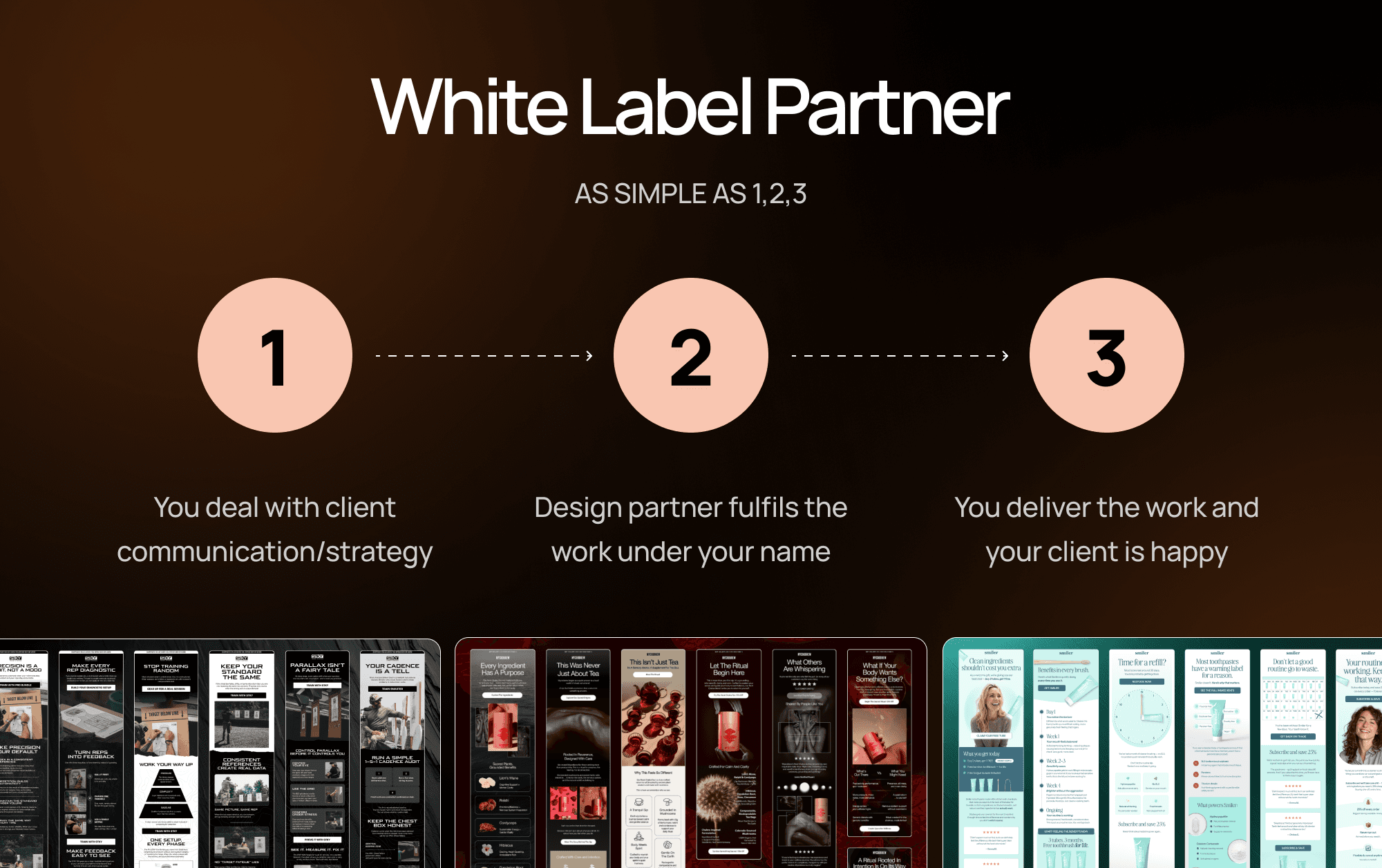
It's a design team that creates emails for your agency's clients under your agency's name. Your clients deal only with you, and the partner delivers designs to your team for review and handover. For the full picture, read our complete guide to white-label email design.
How do I know if a white-label partner is reliable?
Ask for turnaround times measured from a complete brief and speak to an agency they already work with. Then let a short trial show you how they handle real briefs, and track turnaround, revision rounds and your own time spent while it runs.
Should a white-label partner sign an NDA?
Yes. You're sharing client brand guides, offer calendars and sometimes sales data. A partner that works with agencies should sign one without hesitation and explain who on their team can see client files.
Who owns the designs from a white-label partner?
Agree this in writing before you start. In most agency setups, the agency owns the final designs and receives editable source files, usually in Figma, so it can make small changes or switch partners later.
How long should a white-label partner trial last?
A month is usually enough to see real patterns. Use two brands, including your strictest one, and cover at least a few campaigns and one flow, so you see both quick turnarounds and longer projects.
If you'd like to put Marz through these 15 questions yourself, book a call and we'll answer each one with real examples.
Liked it? Share it with your people.


Us Vs Them
Launch your creative to new realms — fast, reliable, and scalable
Large agencies spread thin often lack the focus and flexibility to bring your visions to life.
Cover some needs well, but struggle with skill gaps and aren’t easily scalable.
Finding the right freelancer can be awesome, until they reach capacity or you suddenly get ghosted.
More Blogs
Marz Media is a specialized design partner for agencies that need consistent output without capacity issues.

Oct 7, 2026
Why Your Welcome Flow Deserves Better Email Design
Design a welcome flow that makes a strong first impression. Learn how better email design can improve brand consistency, guide conversions, and build long-term subscriber engagement.
READ MORE

Oct 7, 2026
Why Do Your Emails Still Miss the Mark If the Brief Was Good?
Discover why clear email design briefs may miss the mark and how aligning strategy, CTA hierarchy, and technical specs leads to stronger first-draft designs.
READ MORE
Mar 3, 2026
White Label Email Design: The Complete Guide for Ecom Agencies
Complete guide to white label email design for ecom agencies: how it works, why agencies outsource, how to choose a partner and the mistakes to avoid.
READ MORE