As an email marketing agency grows, campaign volume inevitably increases. What starts as managing a handful of custom email sends each week quickly transforms into producing dozens of campaigns across multiple client accounts.
At a lower volume, bespoke visual design for every single campaign is manageable. But as send frequency and client rosters expand, design teams often hit a wall. Production timelines stretch, revision loops multiply, and overall design quality begins to suffer under the weight of tight deadlines.
Many agencies assume that scaling email marketing requires a compromise: either accept lower visual standards to push out higher volume or cap production capacity to protect quality.
That trade-off is completely unnecessary. Scaling email campaigns successfully isn't about rushing design work or cutting visual corners; it is about building an email production workflow designed for repeatability, speed, and structural precision.
What Does Scaling Email Marketing Actually Mean?
To many marketing teams, scaling email marketing simply means sending more emails to bigger subscriber lists. But from an operational standpoint within an agency, true scalability is defined by production efficiency. Scaling your agency without adding more designers.
Scaling email marketing means increasing campaign output, segment variation, and deployment frequency while keeping headcount, design standards, and production costs predictable.
It involves shifting away from a reactive, one-off creation mindset toward a structured, systems-driven approach. When executed correctly, a scalable production model allows an agency to:
Support higher campaign frequencies smoothly, such as expanding from weekly newsletters into multi-branch automated flows.
Handle complex personalization and dynamic content across diverse subscriber segments without visual breaks.
Manage email production across a growing portfolio of clients without expanding core design staff proportionally.
Maintain consistent visual hierarchy, brand integrity, and rendering reliability on every single send.
Why Email Design Becomes a Bottleneck as You Scale
Email design is fundamentally different from web or print design. Every asset must navigate strict HTML rendering constraints, responsive email designs for mobile layouts, and varying display engines, from Apple Mail to legacy versions of Microsoft Outlook.
When an agency attempts to scale email output without adjusting its design workflow, three major bottlenecks emerge:
Designing Every Layout from Scratch: Treating every promotional push or newsletter as a blank canvas wastes strategic and creative hours on structural decisions that have already been solved in past campaigns.
Inconsistent Brand Application: When multiple designers work across tight client deadlines without standardized rules, brand consistency erodes. Font sizes drift, CTA styling varies, and spatial padding becomes haphazard.
Endless Revision and QA Cycles: Without standardized production constraints, design bugs that are like broken mobile scaling, misaligned layout tables, or unreadable dark mode text are caught late in the process, triggering redundant revision rounds right before deployment.
To eliminate these bottlenecks, the goal isn't to restrict creativity; it is to eliminate repetitive structural work.
Build a Modular Email Design System
The single most effective way to scale email design without sacrificing quality is to transition from custom static templates to a modular email design system.
A modular design system is a comprehensive library of pre-designed, pre-tested HTML email components such as hero headers, product grids, article listings, social proof blocks, and CTA sections that can be mixed, matched, and reordered.
Instead of designing an entire email from scratch, your team builds a strategic composition using pre-approved visual modules:
Hero Module: Sets the campaign hook with high-impact imagery and the primary headline.
Value Proposition Block: Delivers supporting context or core benefits in a clean, scannable format.
Product Grid Component: Displays items in a balanced two-column or three-column layout.
Primary Call-to-Action Block: Guides the subscriber toward a single conversion goal with strong visual contrast.
Advantages of an Email-Design Modular System for Agencies
Accelerated Production: Production time drops from hours to minutes because the baseline structure and responsive code are already built and verified.
Guaranteed Responsiveness: Every module is pre-tested across major email clients and mobile screen sizes, virtually eliminating layout breaks during deployment.
Strategic Focus: Rather than debating baseline padding or button radius for every send, your team can focus on campaign messaging, offer hierarchy, and conversion strategy.
Create Reusable Email Components Without Making Every Email Look the Same
A common concern agencies have regarding modular email design is that emails will start looking repetitive or "cookie-cutter."
This only happens when a design system is too rigid. A well-constructed modular system provides structure while offering high visual flexibility through variable styling controls:
Flexible Content Containers: Build modules that support interchangeable media, such as switching between full-bleed hero images, split-screen graphics, or typography-focused background blocks.
Variable Layout Stacking: Enable modules to shift between single-column, two-column grid, and zigzag patterns depending on the content length and narrative flow.
Dynamic Color Tokens: Assign global color variables so a module’s background, text, and button styling can instantly shift to match a specific campaign theme while remaining strictly within brand guidelines.
Diverse Typography Controls: Use standardized typographic hierarchy scales (H1, H2, body, caption) that maintain proportional balance regardless of copy length.
By varying component order, imagery style, and color accents, your team can produce hundreds of unique campaign layouts derived from the exact same core module library.
Scale Email Marketing: Standardize the Production Workflow, Not the Creative Thinking
Scaling email campaign production requires clear boundaries between strategy, copywriting, visual assembly, and technical execution. When workflow stages overlap without clear ownership, friction rises and turnaround times slow down.
A scalable email production workflow follows a standardized sequence:
Stage 1: Strategy & Brief: The campaign objectives, message hierarchy, and target audience context are clearly defined. More about email marketing client onboarding.
Stage 2: Approved Copy: Copy is finalized and locked before visual work begins to prevent late-stage structural readjustments.
Stage 3: Modular Assembly: The copy hierarchy is mapped directly to pre-built visual modules to create the foundational layout.
Stage 4: Custom Visuals: Creative effort is focused where it matters most, custom hero graphics, animated GIFs, brand-specific iconography, and curated product imagery.
Stage 5: Automated QA & Handoff: The email undergoes technical testing across clients and dark mode before client review or final deployment.
Standardizing the production pipeline ensures creative energy is spent on high-impact visual storytelling rather than administrative layout fixes.
Scale Email Production Across Multiple Clients
For growing agencies, managing email design scalability across a portfolio of diverse client accounts adds another layer of operational complexity. Each account brings distinct brand guidelines, ESP environments, and audience expectations.
To scale across multiple clients seamlessly:
Develop Client-Specific Master Design Systems: Build a master modular library for each recurring client during onboarding. Once established, ongoing campaign assembly becomes fast, reliable, and predictable.
Establish Cross-Client Production Guidelines: Train designers on a universal spatial grid system and standard typography rules so team members can switch between client accounts without losing speed or precision.
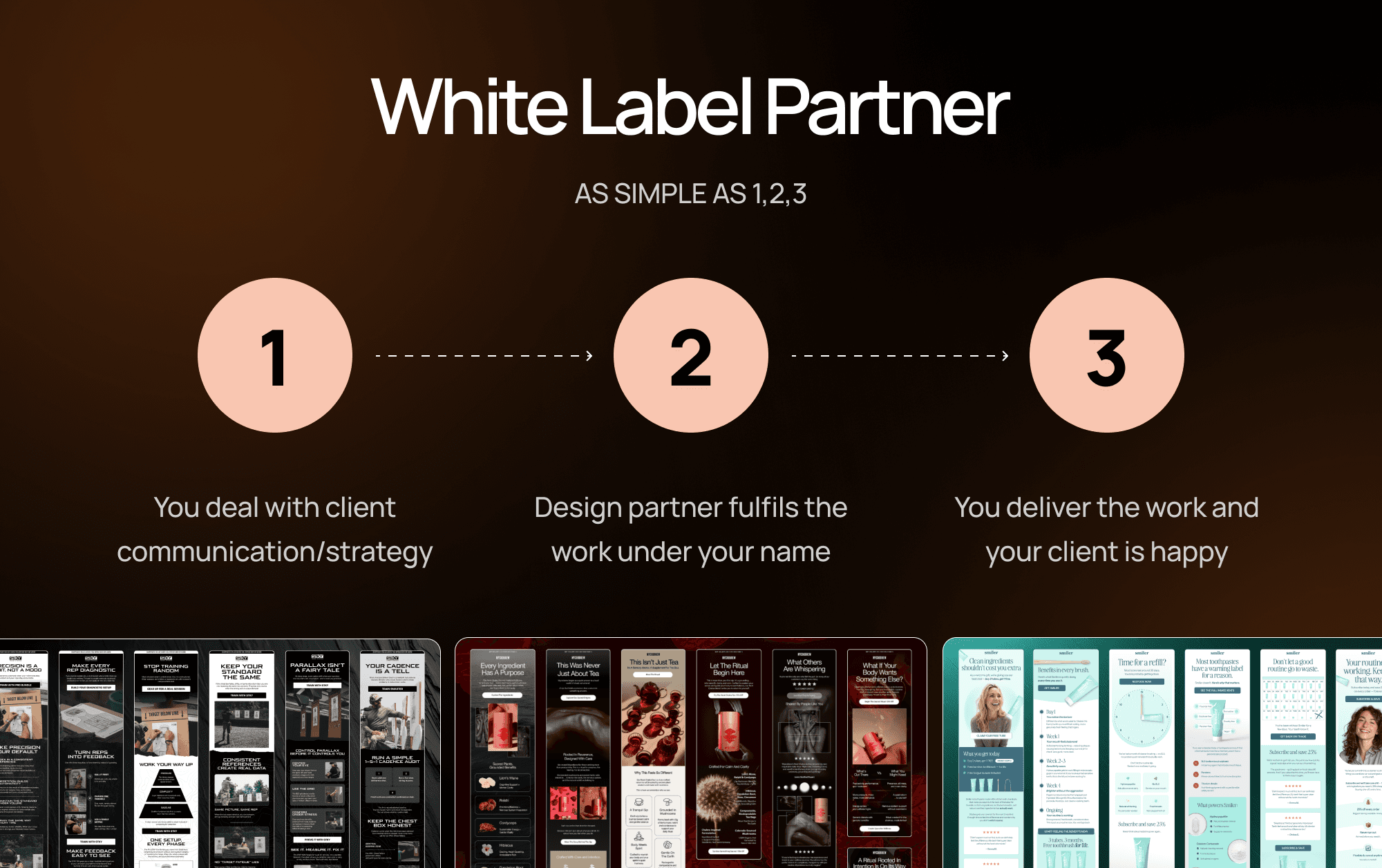
Leverage Specialized External Partners: When internal campaign volumes exceed bandwidth, partnering with a specialized white-label email design partner allows your agency to scale execution capacity instantly without adding fixed operational overhead.
Build QA Into the System to Scale Your Emails
Quality assurance (QA) should never be an afterthought squeezed in minutes before an email is sent. As campaign volume scales, manual QA becomes highly prone to human error.
Integrating systematic email QA directly into your production process ensures that high output never leads to broken rendering or compromised user experience:
Pre-Rendered Component Testing: Test core HTML components in tools like Litmus or Email on Acid before adding them to your live design library. Once a module passes inspection, every campaign using it carries minimal rendering risk.
Standardized Testing Checklists: Every campaign should be verified against a strict pre-flight checklist covering dark mode stability, image alt-text, mobile touch-target button dimensions, readability contrast, and live tracking links.
Automated Rendering Previews: Run full campaign previews across top email clients (Apple Mail, Gmail, Outlook, and mobile devices) as an automated final step prior to client approval handoff.
A standardized email design checklist can help catch rendering and accessibility issues before client review.
When Should You Outsource Email Design?
Building and maintaining internal design systems takes time and dedicated resources. As campaign demands rise, agency leadership must evaluate whether building every campaign in-house is the most efficient use of team bandwidth.
Outsourcing email design or bringing in an external white-label email design partner makes strategic sense when:
Capacity Peaks Outstrip Staffing: Your strategy team is closing new accounts or expanding campaign scope, but hiring full-time designers creates long-term overhead risks.
Turnaround Times Are Lagging: Production bottlenecks are slowing down campaign launches, resulting in missed marketing windows and frustrated clients.
Specialized Technical Expertise Is Needed: Your internal team excels at campaign strategy and copywriting but struggles with advanced HTML/CSS email rendering, dark mode optimization, or building modular systems.
Partnering with an external email design specialist gives your agency immediate access to established modular workflows, allowing you to focus on strategy, client management, and account growth.
How to Know If Your Email Production System Is Ready to Scale
Before attempting to double your agency's email campaign volume, evaluate your current operational readiness against these key indicators:
Component Library: You have a central library of pre-tested, responsive email modules rather than building every campaign as a standalone, isolated design file.
Clear Workflow Ownership: There is a strict separation between copy lock-in, visual assembly, and client approval steps.
Turnaround Consistency: Your team can accurately estimate design completion times within a tight window across different campaign types.
Low Revision Metrics: First-draft designs consistently pass internal and client review with minimal structural revisions.
Predictable QA: Rendering bugs are caught automatically during internal review rather than by the client post-delivery.
If your agency checks these boxes, your design operations are well-positioned to handle increased campaign volume smoothly. If not, implementing a modular design system and refining your handoff workflow is the essential first step toward sustainable growth.
Ready to Scale Your Email Production?
Scaling your email marketing doesn’t have to mean adding more designers, stretching your team thinner, or compromising the quality your clients expect.
Marz works as an extension of your agency’s team, taking email design production off your plate so you can handle more campaigns and more clients without slowing down your workflow.
From recurring campaign design to modular systems and high-volume production, we help agencies build the design capacity they need to scale while keeping every email on brand, on time, and ready to perform.
Ready to scale your email marketing without adding more to your team? Let’s talk.
Liked it? Share it with your people.


Us Vs Them
Launch your creative to new realms — fast, reliable, and scalable
Large agencies spread thin often lack the focus and flexibility to bring your visions to life.
Cover some needs well, but struggle with skill gaps and aren’t easily scalable.
Finding the right freelancer can be awesome, until they reach capacity or you suddenly get ghosted.
More Blogs
Marz Media is a specialized design partner for agencies that need consistent output without capacity issues.
Oct 7, 2026
Why Your Welcome Flow Deserves Better Email Design
Design a welcome flow that makes a strong first impression. Learn how better email design can improve brand consistency, guide conversions, and build long-term subscriber engagement.
READ MORE
Oct 7, 2026
Why Do Your Emails Still Miss the Mark If the Brief Was Good?
Discover why clear email design briefs may miss the mark and how aligning strategy, CTA hierarchy, and technical specs leads to stronger first-draft designs.
READ MORE
Mar 3, 2026
White Label Email Design: The Complete Guide for Ecom Agencies
Everything ecom email marketing agencies need to know about white label email design — what it is, how it works, and how to find the right partner.
READ MORE